
Find Death Records in Washtenaw County
Washtenaw County death records are kept by the County Clerk's office in Ann Arbor. The office has maintained records going back to 1867 and issues certified death certificates for all deaths that occurred within the county. This page explains how to get a Washtenaw County death certificate, what it costs, and which resources are available to help with your search.
Washtenaw County Death Records Overview
Washtenaw County Clerk Office
The Washtenaw County Clerk and Register of Deeds is located at 200 N. Main Street in Ann Arbor. This office handles vital records for the county, including certified death certificates for all deaths that occurred within Washtenaw County. In-person requests and mail-in submissions are both accepted.
| Address | 200 N. Main Street, Ann Arbor, MI 48104 |
|---|---|
| Phone | (734) 222-6700 |
| Fax | (734) 222-6705 |
| Hours | Monday-Friday, 8:00 AM - 4:00 PM |
| Website | washtenaw.org |
The clerk's office closes at 4:00 PM on weekdays. If you plan to visit in person, arrive before 3:30 PM to allow time for your request to be processed. Payment is accepted by cash, check, or money order. Checks should be made payable to Washtenaw County Clerk.
The screenshot above shows the Clerk Register of Deeds page at washtenaw.org, where you can find vital records request instructions and additional contact details.
How to Request Washtenaw County Death Records
Death certificates from Washtenaw County can be obtained in person or by mail. Walk-in visits to the Ann Arbor office are the fastest method. Most in-person requests are filled the same day. Mail requests take longer since the office must process your request and return the certificate by mail.
Under MCL 333.2882, Michigan death records are public records. Any person can request a certified copy without needing to prove a family relationship or give a reason. This rule applies the same way across all 83 Michigan counties, including Washtenaw.
For a mail request, write a letter with the full legal name of the deceased, the date or year of death, and the city or township in Washtenaw County where the death occurred. Include your payment, a photocopy of your photo ID, and a self-addressed stamped envelope. Send everything to the clerk's address at 200 N. Main Street, Ann Arbor, MI 48104.
The Washtenaw County website at washtenaw.org has additional guidance for vital records requests, including downloadable request forms when available.
Death Certificate Fees in Washtenaw County
The Washtenaw County Clerk charges $15 for the first certified death certificate. If you need more copies of the same record in the same order, each additional copy costs $5. Make checks payable to Washtenaw County Clerk. Cash and money orders are also accepted.
If you need the record for more than one purpose, such as for an estate, insurance, and a bank account, order all copies at once. The $5 rate for additional copies is much lower than paying $15 again on a separate request. One submission can cover all your needs.
Note: VitalChek offers online ordering for Washtenaw County but charges an additional convenience fee on top of the county rate. Check directly with the clerk for the most current fee schedule.
What to Include in Your Request
The Washtenaw County Clerk needs enough details to find the correct record. Incomplete requests may be returned or delayed. Here is what to include:
- Full legal name of the deceased
- Date of death or approximate year
- City or township in Washtenaw County where the death occurred
- Your name and return mailing address
- Payment for the applicable fee
- A photocopy of your government-issued photo ID
Per MCL 333.2895, original death records are not open for public inspection. The clerk issues only certified copies, which carry the official seal. Certified copies are the accepted legal form of proof for estate proceedings, insurance claims, and financial institutions.
Online Resources for Washtenaw County Death Records
Michigan's free GENDIS genealogical death index covers over 460,000 records from 1867 to 1897. You can search by name and year to check whether a record exists before submitting a formal request. Washtenaw County has many historical records in the index given its long-established population.
For records from 1897 through 1952, Michiganology provides free access to digitized Michigan death certificates through the Archives of Michigan. Images are available for records more than 75 years old. This is a good starting point for genealogy research in the Ann Arbor area.
The Michigan MDHHS vital records portal below shows the statewide system for ordering and accessing records. The michigan.gov/mdhhs portal also connects to VitalChek for online ordering with a credit card.
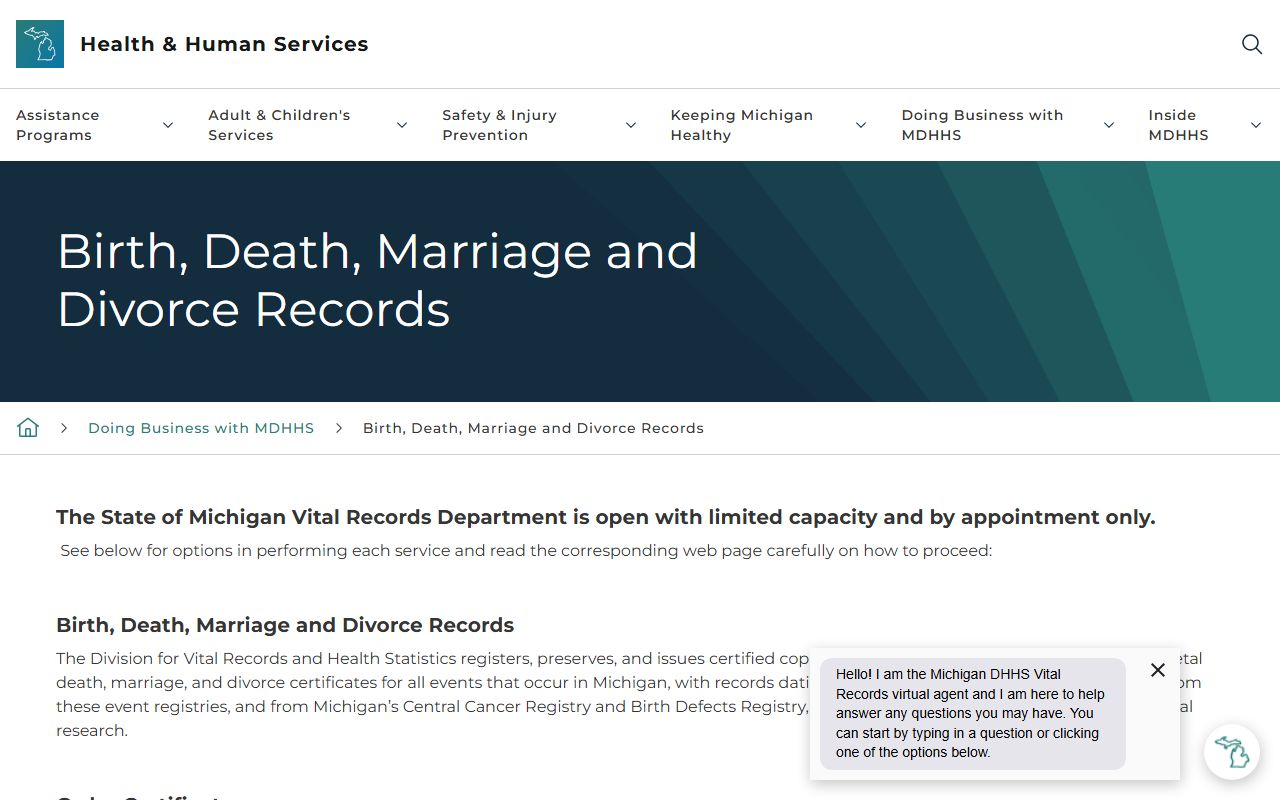
The state vital records portal provides links and guidance for ordering death certificates from county clerks across Michigan, including Washtenaw County.
Michigan Death Record Laws
Washtenaw County death records follow Michigan's Public Health Code. The key statutes set the rules for access and how the clerk issues records.
MCL 333.2882 makes death records public in Michigan. Any person can ask for a certified copy. No proof of relationship or legal purpose is required. This open-access policy is the same in Washtenaw County as in every other county in the state.
MCL 333.2888(1) exempts vital records from the Freedom of Information Act. A FOIA request will not get you a death certificate. You must use the county clerk's vital records request process under the Public Health Code.
MCL 333.2895 bars public inspection of original death records. The Washtenaw County Clerk issues only certified copies, which carry the official seal and are legally valid for estate, insurance, and financial purposes.
Cities in Washtenaw County
Ann Arbor is the county seat and the largest city in Washtenaw County. Deaths that occurred in Ann Arbor or anywhere else in the county are recorded by the Washtenaw County Clerk.
Nearby Counties
If the death occurred in a neighboring county, contact that county's clerk office directly. The right office is based on where the death took place, not where the deceased lived.